


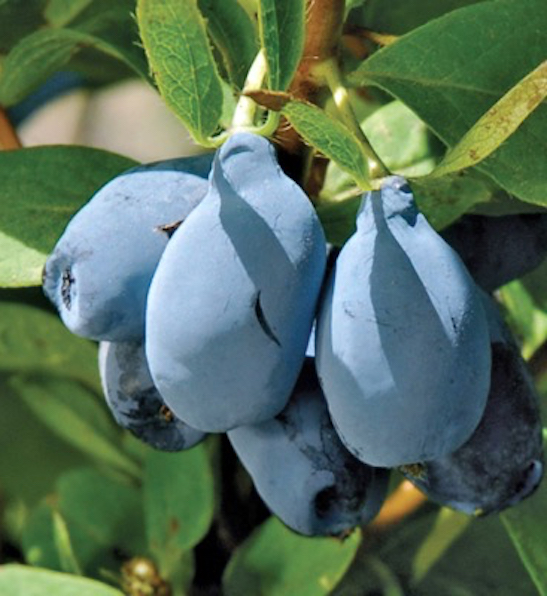

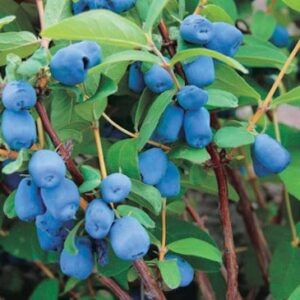
Lonicera caerulea 'Blue Pagoda' ('Chitose #11') (late-season)
Blue Pagoda Haskap Berry Bush, Blue Pagoda Honeyberry Bush, Blue Pagoda Blue Honeysuckle
$19.99 - $49.99
- Main interest:
- large juicy sweet berry, firm texture, late blooming variety, widely grown in Japan
- Exposure:
- full sun to partial shade
- Soil humidity:
- moist soil; well drained
- Flower colour:
- pale yellow white
- Fragrance:
- mildly fragrant
- Flowering period:
- May
- Foliage:
- green
- USDA Hardiness:
- zone 2a: -45.5 °C (-50 °F) View Zone Map
- Mature height & width:
- height: 5 ft (1.5 m) width: 5 ft (1.5 m)
- Use:
- fruit production, edible garden, orchard, medium hedge, butterfly garden, foundation, container
Blue Pagoda Haskap berry bush produces abundant crops of large, juicy, sweet and flavourful, berries that are dark blue inside and out. A late blooming variety, Blue Pagoda Honeyberry will grow to be about 5 feet tall with an equal spread. Good fall colour. Makes a wonderful medium-sized hedge on its own or mixed with other haskap varieties and other berry bushes. Widely grown and very popular in northern Japan, this valuable variety is loved for its abundant crops.
Honeyberries are very hardy, and adapt well to many climates. Blue Pagoda Honeyberry bush prefers well-drained acidic soil, not unlike blueberry plants; and full sun to partial shade. Lonicera caerulea ‘Blue Pagoda’ will need another late blooming Haskap for pollination, and we recommend Blue Velvet Haskap. Use in edible landscapes, orchards, and containers.
Blue Pagoda Haskap plants will need a year or two to grow before fruit production; and will produce approximately 5 to 10 pounds annually. The berries are great for fresh eating, juicing, and preserves. A very healthful fruit, Haskap berries contain large amounts of antioxidants; such as, anthocyanins, polyphenols, flavonoids, vitamin C, vitamin A, fiber and potassium. They have three times the antioxidants of blueberries, and more vitamin C than oranges.
- Main interest:
- large juicy sweet berry, firm texture, late blooming variety, widely grown in Japan
- Exposure:
- full sun to partial shade
- Soil humidity:
- moist soil; well drained
- Flower colour:
- pale yellow white
- Fragrance:
- mildly fragrant
- Flowering period:
- May
- Foliage:
- green
- USDA Hardiness:
- zone 2a: -45.5 °C (-50 °F) View Zone Map
- Mature height & width:
- height: 5 ft (1.5 m) width: 5 ft (1.5 m)
- Use:
- fruit production, edible garden, orchard, medium hedge, butterfly garden, foundation, container
Blue Pagoda Haskap berry bush produces abundant crops of large, juicy, sweet and flavourful, berries that are dark blue inside and out. A late blooming variety, Blue Pagoda Honeyberry will grow to be about 5 feet tall with an equal spread. Good fall colour. Makes a wonderful medium-sized hedge on its own or mixed with other haskap varieties and other berry bushes. Widely grown and very popular in northern Japan, this valuable variety is loved for its abundant crops.
Honeyberries are very hardy, and adapt well to many climates. Blue Pagoda Honeyberry bush prefers well-drained acidic soil, not unlike blueberry plants; and full sun to partial shade. Lonicera caerulea ‘Blue Pagoda’ will need another late blooming Haskap for pollination, and we recommend Blue Velvet Haskap. Use in edible landscapes, orchards, and containers.
Blue Pagoda Haskap plants will need a year or two to grow before fruit production; and will produce approximately 5 to 10 pounds annually. The berries are great for fresh eating, juicing, and preserves. A very healthful fruit, Haskap berries contain large amounts of antioxidants; such as, anthocyanins, polyphenols, flavonoids, vitamin C, vitamin A, fiber and potassium. They have three times the antioxidants of blueberries, and more vitamin C than oranges.
Synonym(s): Lonicera caerulea var. edulis 'Chitose #11'
Also known as: Blue Pagoda Haskap Plant, Blue Pagoda Haskap Bush, Blue Pagoda Honeyberry Plant, Blue Pagoda Haskap Honeysuckle, Late Blooming Honeyberry, Sweetberry Honeysuckle
Related products
-
Prunus virginiana var. virginiana
Red Chokecherry, Virginia Chokecherry $14.99 - $39.99 Read more This product has multiple variants. The options may be chosen on the product page -
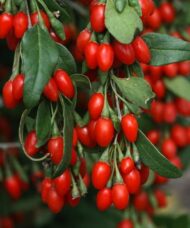
Lycium barbarum 'Dynamite'
Dynamite Goji Berry Plant $6.99 - $39.99 Read more This product has multiple variants. The options may be chosen on the product page -
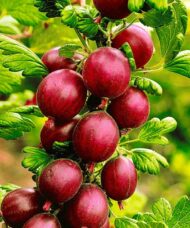
Ribes uva-crispa 'Pixwell'
Pixwell Gooseberry, European Gooseberry Out of stock Read more -
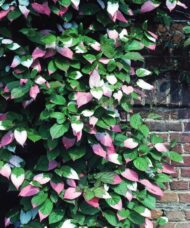
Actinidia kolomikta 'Pasha' (male)
Variegated-leaf Hardy Kiwi (male), Pascha Arctic Kiwi (male), Male Kolomikta Vine $17.99 - $48.99 Read more This product has multiple variants. The options may be chosen on the product page


