


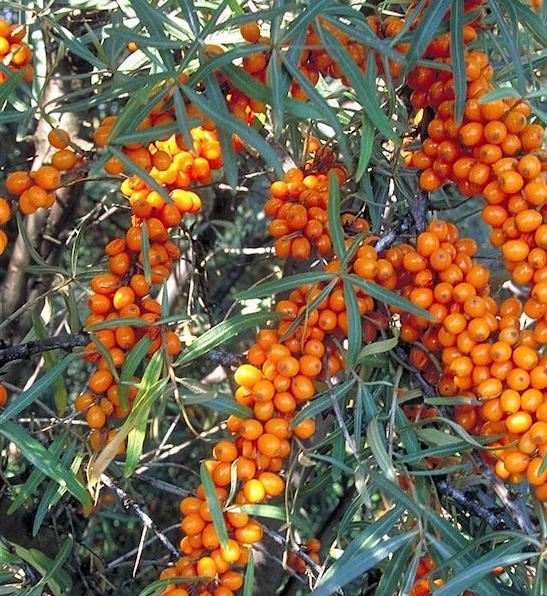


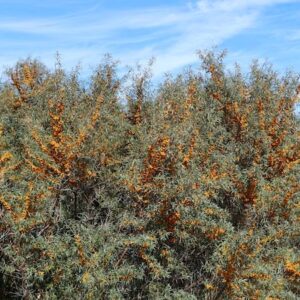
Hippophae rhamnoides 'Frugana' (female)
Sea Buckthorn plant, Frugana Sea Buckthorn, Frugana Seaberry
- Main interest:
- abundant crops, early ripening, flavourful, bright orange-red berries
- Exposure:
- full sun
- Soil humidity:
- dry to moist soil
- Flower colour:
- yellowish-white
- Fragrance:
- Non-fragrant
- Flowering period:
- May
- Foliage:
- greyish-green
- USDA Hardiness:
- zone 3a: -40 °C (-40 °F) View Zone Map
- Mature height & width:
- height: 12 ft (3.6 m) width: 8 ft (2.4 m)
- Use:
- fruit prodcution, hedge, specimen
Frugana Sea Buckthorn plant (Hippophae rhamnoides ‘Frugana’) is a vigorous, highly productive variety, valued for both its ornamental appeal and its exceptional fruit. Also known as Frugana Seaberry, this deciduous shrub features graceful grayish-green foliage - green above and silvery-gray beneath - and is particularly striking in early September when its branches are laden with abundant, bright orange berries. Birdatchers will delight in the abundance of birds drawn to the berries for food.
The fruits are juicy with a pleasing sweet-tart flavour and are exceptionally rich in nutrients, including vitamins A, C, and E, folic acid, carotenoids, antioxidants, and omega-3 and omega-6 fatty acids. This early-fruiting sea buckthorn plant can be harvested by hand, or by cutting fruit-laden branches and freezing them. Once frozen, the berries are easily shaken off, thawed, and used to make juice, as well as preserves such as marmalades, jams, jellies, and syrups.
Sea buckthorn berries also contain medicinally valuable oil. The sea buckthorn plant has been used for centuries in food, traditional medicine, and skincare in its native regions of northwestern Europe and Central Asia. In Canada, sea buckthorn products are widely available in health food stores and pharmacies.
The Sea buckthorn bush is dioecious, and Hippophae rhamnoides ‘Frugana’ is a female variety producing discreet yellow flowers in May. A male plant is required for fruit set; suitable pollinators include Hippophae rhamnoides ‘Gnom’, ‘Lord’, or ‘Pollmix’. One male plant can typically pollinate up to six female plants.
With an upright, bushy growth habit, Frugana Seaberry reaches approximately 4 m in height with a 2.25 m in spread. It can be grown as a multi-stemmed shrub or trained into a single-stem tree. Commonly planted as a specimen for its ornamental qualities, Frugana Sea Buckthorn is also well suited to hedging; its thorny branches make it an effective defensive hedge. As a nitrogen-fixing plant, the sea buckthorn bush thrives in challenging conditions and is often used to rehabilitate poor soils and prevent erosion.
Hardy to zone 3a (-40 °C), Frugana Seaberry is a low-maintenance plant that performs best in full sun and is notably resistant to pests and diseases.
Sea buckthorn, also known as Seaberry or Sallow Thorn, is widely cultivated in Eastern Europe, Russia, and China. It was introduced to Canada in the early 2000s following government-led research into its agricultural potential, with experimental plantings in Manitoba, Saskatchewan, Quebec, and Newfoundland and Labrador. ‘Frugana’ is a German cultivar developed through a breeding program led by the late Hans-Joachim Albrecht in Berlin, and fruit from these German varieties is used extensively for commercial juice production in Germany. Compared with Russian varieties, German Sea Buckthorn varieties exhibit higher fruit acidity, later ripening, and greater overall vigour.
- Main interest:
- abundant crops, early ripening, flavourful, bright orange-red berries
- Exposure:
- full sun
- Soil humidity:
- dry to moist soil
- Flower colour:
- yellowish-white
- Fragrance:
- Non-fragrant
- Flowering period:
- May
- Foliage:
- greyish-green
- USDA Hardiness:
- zone 3a: -40 °C (-40 °F) View Zone Map
- Mature height & width:
- height: 12 ft (3.6 m) width: 8 ft (2.4 m)
- Use:
- fruit prodcution, hedge, specimen
Frugana Sea Buckthorn plant (Hippophae rhamnoides ‘Frugana’) is a vigorous, highly productive variety, valued for both its ornamental appeal and its exceptional fruit. Also known as Frugana Seaberry, this deciduous shrub features graceful grayish-green foliage - green above and silvery-gray beneath - and is particularly striking in early September when its branches are laden with abundant, bright orange berries. Birdatchers will delight in the abundance of birds drawn to the berries for food.
The fruits are juicy with a pleasing sweet-tart flavour and are exceptionally rich in nutrients, including vitamins A, C, and E, folic acid, carotenoids, antioxidants, and omega-3 and omega-6 fatty acids. This early-fruiting sea buckthorn plant can be harvested by hand, or by cutting fruit-laden branches and freezing them. Once frozen, the berries are easily shaken off, thawed, and used to make juice, as well as preserves such as marmalades, jams, jellies, and syrups.
Sea buckthorn berries also contain medicinally valuable oil. The sea buckthorn plant has been used for centuries in food, traditional medicine, and skincare in its native regions of northwestern Europe and Central Asia. In Canada, sea buckthorn products are widely available in health food stores and pharmacies.
The Sea buckthorn bush is dioecious, and Hippophae rhamnoides ‘Frugana’ is a female variety producing discreet yellow flowers in May. A male plant is required for fruit set; suitable pollinators include Hippophae rhamnoides ‘Gnom’, ‘Lord’, or ‘Pollmix’. One male plant can typically pollinate up to six female plants.
With an upright, bushy growth habit, Frugana Seaberry reaches approximately 4 m in height with a 2.25 m in spread. It can be grown as a multi-stemmed shrub or trained into a single-stem tree. Commonly planted as a specimen for its ornamental qualities, Frugana Sea Buckthorn is also well suited to hedging; its thorny branches make it an effective defensive hedge. As a nitrogen-fixing plant, the sea buckthorn bush thrives in challenging conditions and is often used to rehabilitate poor soils and prevent erosion.
Hardy to zone 3a (-40 °C), Frugana Seaberry is a low-maintenance plant that performs best in full sun and is notably resistant to pests and diseases.
Sea buckthorn, also known as Seaberry or Sallow Thorn, is widely cultivated in Eastern Europe, Russia, and China. It was introduced to Canada in the early 2000s following government-led research into its agricultural potential, with experimental plantings in Manitoba, Saskatchewan, Quebec, and Newfoundland and Labrador. ‘Frugana’ is a German cultivar developed through a breeding program led by the late Hans-Joachim Albrecht in Berlin, and fruit from these German varieties is used extensively for commercial juice production in Germany. Compared with Russian varieties, German Sea Buckthorn varieties exhibit higher fruit acidity, later ripening, and greater overall vigour.
Also known as: Frugana Sallow Thorn, Frugana Sea Buckthorn Bush, Frugana Sea buckthorn Shrub, Frugana Sea Buckthorn Tree, Sea Berry Plant, Sea Berry Tree, Sea Berry Bush, Female Sea Buckthorn, Sandthorn, Siberian pineapple
Related products
-
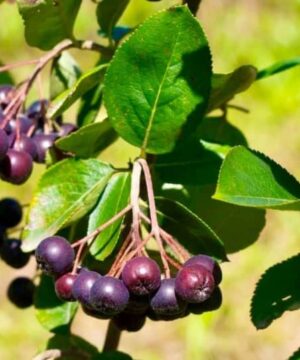
Aronia melanocarpa 'McKenzie'
McKenzie Black Chokeberry, Aronia Berry Out of stock Read more -
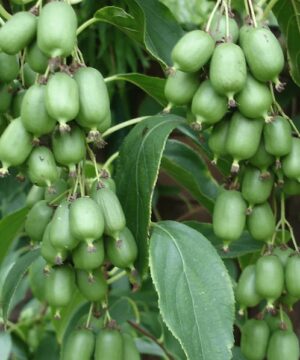
Actinidia arguta 'Issaï' (self-fertile) (female)
Issaï Hardy Kiwi Vine, Issaï Kiwi Plant, Issaï Self-pollinating Kiwi$21.99 - $60.99$17.59 - $48.79 Read more This product has multiple variants. The options may be chosen on the product page -
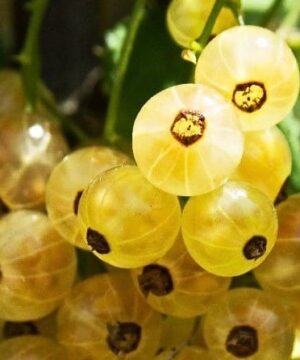
Ribes rubrum 'White Pearl' (late-season)
White Pearl White Currant$17.99$14.39 Read more This product has multiple variants. The options may be chosen on the product page -

Rubus fruticosus 'Chester'
Chester Hardy Blackberry, Chester Blackberry Out of stock Read more


