




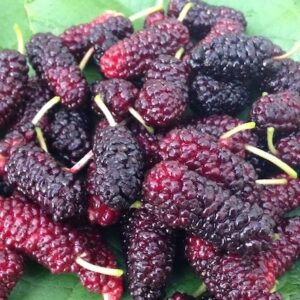
Morus alba x rubra 'Illinois Everbearing'
Illinois Everbearing Mulberry
- Main interest:
- early ripening, long fruiting period, tasty black fruit, self-fertile
- Exposure:
- full sun to partial shade
- Soil humidity:
- moist soil; well drained
- Flower colour:
- yellowish-green
- Fragrance:
- Non-fragrant
- Flowering period:
- May
- Foliage:
- glossy green
- USDA Hardiness:
- zone 4b: -31.5 °C (-25 °F) View Zone Map
- Mature height & width:
- height: 30 ft (9 m) width: 20 ft (6 m)
- Use:
- fruit production, street tree, specimen
Illinois Everbearing Mulberry (Morus alba × rubra ‘Illinois Everbearing’) is a culinary mulberry prized for its exceptionally long fruiting season, from July through September - hence the name ‘Everbearing’. It offers both outstanding edible and ornamental qualities.
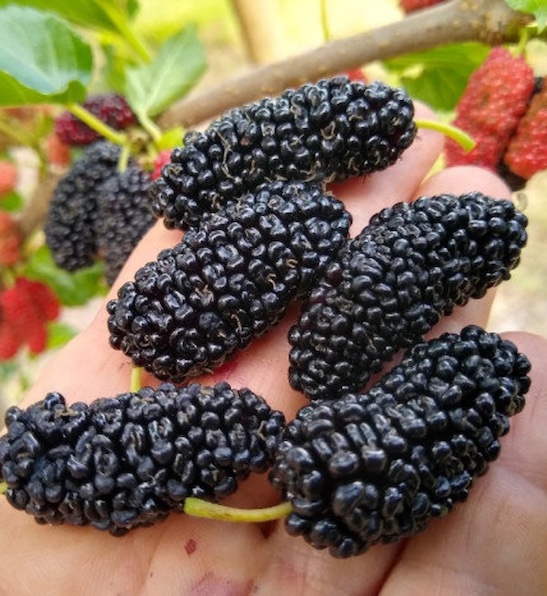
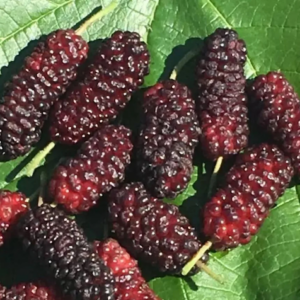
The bluish-black berry (botanically an elongated cluster of drupes) resembles a blackberry, up to 4 cm (1.5 in) long. The fruit is nearly seedless, very juicy, and richly sweet, making it excellent for fresh eating or as a topping for yogurt, ice cream, or cereal. Illinois Everbearing Mulberry fruit is also well suited to baking (often used as a blackberry substitute), pies, and preserves such as jams, jellies, and syrups. A mature, established Illinois Everbearing Mulberry plant can yield up to 11 kg (25 lb) of fruit annually.
This vigorous deciduous Illinois Everbearing Mulberry plant grows quickly, reaching up to 9 m (30 ft), and often bears fruit in its first year after planting. Illinois Everbearing Mulberry is an attractive, medium-sized shade tree with a dense, spreading crown. Inconspicuous greenish-yellow male and female flowers bloom in May, and the tree is self-fertile. The glossy green leaves are often deeply lobed on young growth, becoming more ovate and unlobed with maturity. The bark is gray-brown with long, scaly ridges. Birdwatchers will appreciate the many species drawn to the fruit - especially gray catbirds - while some mammals are also known to indulge.
Morus 'Illinois Everbearing' prefers moist, well-drained soil and grows best in full sun to partial shade. It is particularly cold-hardy, tolerating temperatures down to Zone 4b (-31.5 °C). Some maintenance is required to manage its spreading habit; dormant pruning is recommended to avoid sap bleed.
Morus alba (white mulberry) is believed to have begun hybridizing with the native Morus rubra (red mulberry) shortly after its introduction to North America in the 17th century. Although in the wild, these hybrid forms are considered a threat to the survival of Morus rubra, several hybrid forms - including Morus alba × rubra ‘Illinois Everbearing' - have been selected and valued for their exceptional horticultural merits.
- Main interest:
- early ripening, long fruiting period, tasty black fruit, self-fertile
- Exposure:
- full sun to partial shade
- Soil humidity:
- moist soil; well drained
- Flower colour:
- yellowish-green
- Fragrance:
- Non-fragrant
- Flowering period:
- May
- Foliage:
- glossy green
- USDA Hardiness:
- zone 4b: -31.5 °C (-25 °F) View Zone Map
- Mature height & width:
- height: 30 ft (9 m) width: 20 ft (6 m)
- Use:
- fruit production, street tree, specimen
Illinois Everbearing Mulberry (Morus alba × rubra ‘Illinois Everbearing’) is a culinary mulberry prized for its exceptionally long fruiting season, from July through September - hence the name ‘Everbearing’. It offers both outstanding edible and ornamental qualities.
The bluish-black berry (botanically an elongated cluster of drupes) resembles a blackberry, up to 4 cm (1.5 in) long. The fruit is nearly seedless, very juicy, and richly sweet, making it excellent for fresh eating or as a topping for yogurt, ice cream, or cereal. Illinois Everbearing Mulberry fruit is also well suited to baking (often used as a blackberry substitute), pies, and preserves such as jams, jellies, and syrups. A mature, established Illinois Everbearing Mulberry plant can yield up to 11 kg (25 lb) of fruit annually.
This vigorous deciduous Illinois Everbearing Mulberry plant grows quickly, reaching up to 9 m (30 ft), and often bears fruit in its first year after planting. Illinois Everbearing Mulberry is an attractive, medium-sized shade tree with a dense, spreading crown. Inconspicuous greenish-yellow male and female flowers bloom in May, and the tree is self-fertile. The glossy green leaves are often deeply lobed on young growth, becoming more ovate and unlobed with maturity. The bark is gray-brown with long, scaly ridges. Birdwatchers will appreciate the many species drawn to the fruit - especially gray catbirds - while some mammals are also known to indulge.
Morus 'Illinois Everbearing' prefers moist, well-drained soil and grows best in full sun to partial shade. It is particularly cold-hardy, tolerating temperatures down to Zone 4b (-31.5 °C). Some maintenance is required to manage its spreading habit; dormant pruning is recommended to avoid sap bleed.
Morus alba (white mulberry) is believed to have begun hybridizing with the native Morus rubra (red mulberry) shortly after its introduction to North America in the 17th century. Although in the wild, these hybrid forms are considered a threat to the survival of Morus rubra, several hybrid forms - including Morus alba × rubra ‘Illinois Everbearing' - have been selected and valued for their exceptional horticultural merits.
Also known as: Illinois Everbearing Mulberry plant, Illinois Everbearing Red Mulberry, Illinois Everbearing Mulberry Hybrid, Early-ripening Mulberry, Hybrid Mulberry
Related products
-
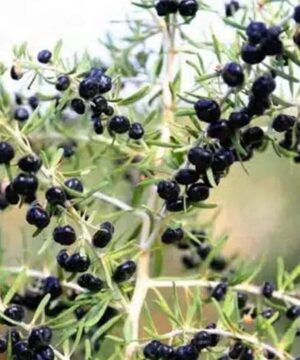
Lycium ruthenicum
Black Goji Berry, Russian Box Thorn, Black Fruit Wolfberry$17.99 - $47.99$14.39 - $38.39 Read more This product has multiple variants. The options may be chosen on the product page -
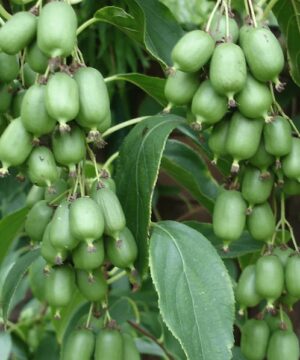
Actinidia arguta 'Issaï' (self-fertile) (female)
Issaï Hardy Kiwi Vine, Issaï Kiwi Plant, Issaï Self-pollinating Kiwi$21.99 - $60.99$17.59 - $48.79 Read more This product has multiple variants. The options may be chosen on the product page -
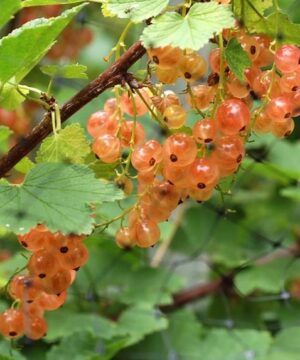
Ribes rubrum 'Pink Champagne' (mid-season)
Pink Champagne Pink Currant$18.99$15.19 Read more This product has multiple variants. The options may be chosen on the product page -

Ribes uva-crispa 'Pixwell'
Pixwell Gooseberry, European Gooseberry Out of stock Read more


