



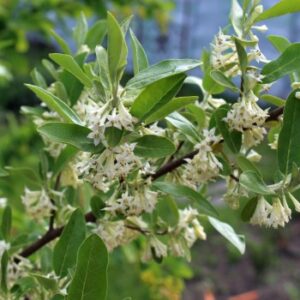
Elaeagnus umbellata 'Hidden Springs'
Hidden Springs Autumn Olive Bush, Hidden Springs Autumn Olive Plant, Hidden Springs Japanese Silverberry
$18.99 - $52.99 $16.99 - $45.99
- Main interest:
- very large edible berries, low astringency, self-fertile, fragrant flowers, nitrogen fixing shrub
- Exposure:
- full sun
- Soil humidity:
- dry to moist soil; well-drained
- Flower colour:
- silvery white
- Fragrance:
- Fragrant
- Flowering period:
- May to June
- Foliage:
- silvery green
- USDA Hardiness:
- zone 4a: -34.5 °C (-30 °F) View Zone Map
- Mature height & width:
- height: 15 ft (4.5 m) width: 20 ft (6 m)
- Use:
- fruit production, orchard, specimen, hedge, xeriscaping
Elaeagnus umbellata 'Hidden Springs' (Autumn Olive Bush) is a deciduous shrub, producing high yields of edible fruits. The nutritious fruit is a great source of vitamins A, C, E, flavonoids; and is extremely high in lycopene, a heart healthful antioxidant.
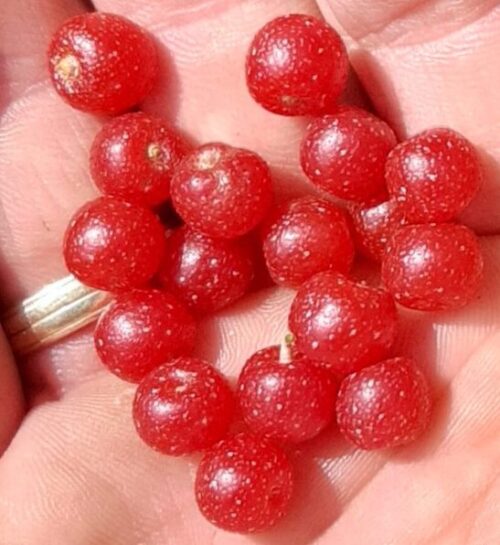
From Tennessee (USA), Elaeagnus umbellata 'Hidden Springs' was developed by Hector Black at Hidden Springs nursery. Selectively bred over Hector's 20 years autumn olive breeding program, it offers one of the largest Elaeagnus' fruits (comparable to Brilliant Rose's berry in size). The oval, silvery speckled, bright red autumn olive berries are sweet, favourful, slightly astringent, and soft seeded. The fruit can be enjoyed raw, dried, in juices or cooked in pies and preserves. The unique red fruit makes also a colourful addition to fall fruit salads. Hidden Springs Autumn Olive Bush is self-fertile. Planting other varieties nearby for cross-pollination (such as 'Amber', 'Brilliant Rose' or 'Ruby') could increase fruit yield.
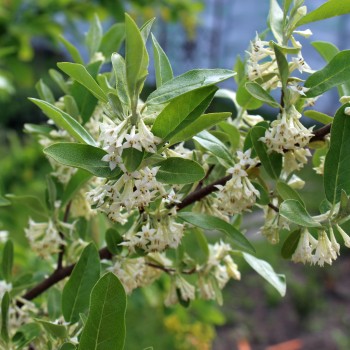
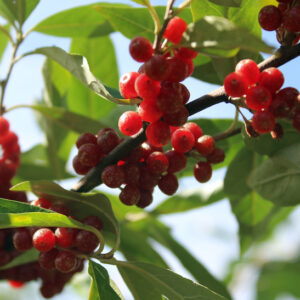
Hidden Springs Autumn Olive plant is a highly ornamental shrub with attractive, narrowly oval-shaped leaves that have distinctive silvery scaled undersides and silvery gold, thorny branches. A stunning display of fragrant, creamy white, funnel-shaped flowers appear between May and June. The abundant, early blooms are beneficial for pollinator species searching for an early food source. Birds relish the fruit and bees love the profuse,fragrant white flowers. The showyfruits look beautiful when drooping in mass.
While the berries may appear ready to consume earlier, it is recommended to wait until they are very soft and almost over-ripe for the sweetest possible flavour. Berries can usually be consumed in late September but they will get the sweetest by the end of October. Elaeagnus umbellata 'Hidden Springs' will start bearing fruits within 2 to 3 years after planting. Autumn Olive bushes are unchallenged in their fruit production with one plant capable of providing 80 pounds of edible fruit a year.
A rather robust plant, Hidden Springs Japanese Silverberry is disease and pest resistant and can be grown in hardiness zone 4a (-34 °C). It has been used for erosion control, soil remediation, windbreaks, and wildlife food/habitat. This nitrogen fixing shrub is very adaptable, tolerating poor rocky or sandy soil, salt, drought, and air pollution. The root system can form a symbiotic relationship with the bacteria actinobacterium Frankia that can catch atmospheric nitrogen and stock it in the ground to feed it to surrounding plants.
Due to its enormous fruit yield, ability to self-seed, and spreading by root suckers, Hidden Springs Autumn Olive plant can out-compete and displace other nearby plant species. Use caution when choosing plant location and when discarding seeds. Remove suckers at the base to control spread as desired.
- Main interest:
- very large edible berries, low astringency, self-fertile, fragrant flowers, nitrogen fixing shrub
- Exposure:
- full sun
- Soil humidity:
- dry to moist soil; well-drained
- Flower colour:
- silvery white
- Fragrance:
- Fragrant
- Flowering period:
- May to June
- Foliage:
- silvery green
- USDA Hardiness:
- zone 4a: -34.5 °C (-30 °F) View Zone Map
- Mature height & width:
- height: 15 ft (4.5 m) width: 20 ft (6 m)
- Use:
- fruit production, orchard, specimen, hedge, xeriscaping
Elaeagnus umbellata 'Hidden Springs' (Autumn Olive Bush) is a deciduous shrub, producing high yields of edible fruits. The nutritious fruit is a great source of vitamins A, C, E, flavonoids; and is extremely high in lycopene, a heart healthful antioxidant.
From Tennessee (USA), Elaeagnus umbellata 'Hidden Springs' was developed by Hector Black at Hidden Springs nursery. Selectively bred over Hector's 20 years autumn olive breeding program, it offers one of the largest Elaeagnus' fruits (comparable to Brilliant Rose's berry in size). The oval, silvery speckled, bright red autumn olive berries are sweet, favourful, slightly astringent, and soft seeded. The fruit can be enjoyed raw, dried, in juices or cooked in pies and preserves. The unique red fruit makes also a colourful addition to fall fruit salads. Hidden Springs Autumn Olive Bush is self-fertile. Planting other varieties nearby for cross-pollination (such as 'Amber', 'Brilliant Rose' or 'Ruby') could increase fruit yield.
Hidden Springs Autumn Olive plant is a highly ornamental shrub with attractive, narrowly oval-shaped leaves that have distinctive silvery scaled undersides and silvery gold, thorny branches. A stunning display of fragrant, creamy white, funnel-shaped flowers appear between May and June. The abundant, early blooms are beneficial for pollinator species searching for an early food source. Birds relish the fruit and bees love the profuse,fragrant white flowers. The showyfruits look beautiful when drooping in mass.
While the berries may appear ready to consume earlier, it is recommended to wait until they are very soft and almost over-ripe for the sweetest possible flavour. Berries can usually be consumed in late September but they will get the sweetest by the end of October. Elaeagnus umbellata 'Hidden Springs' will start bearing fruits within 2 to 3 years after planting. Autumn Olive bushes are unchallenged in their fruit production with one plant capable of providing 80 pounds of edible fruit a year.
A rather robust plant, Hidden Springs Japanese Silverberry is disease and pest resistant and can be grown in hardiness zone 4a (-34 °C). It has been used for erosion control, soil remediation, windbreaks, and wildlife food/habitat. This nitrogen fixing shrub is very adaptable, tolerating poor rocky or sandy soil, salt, drought, and air pollution. The root system can form a symbiotic relationship with the bacteria actinobacterium Frankia that can catch atmospheric nitrogen and stock it in the ground to feed it to surrounding plants.
Due to its enormous fruit yield, ability to self-seed, and spreading by root suckers, Hidden Springs Autumn Olive plant can out-compete and displace other nearby plant species. Use caution when choosing plant location and when discarding seeds. Remove suckers at the base to control spread as desired.
Synonym(s): Elaeagnus parvifolia 'Hidden Springs'
Also known as: Hidden Springs Autumn Olive Shrub, Hidden Springs Autumn Olive Berry, Hidden Springs Autumn Berry Bush, Hidden Springs Japanese Silver Berry, Hidden Springs Autumn Olive Silverberry, Japanese Silver Berry Tree, Hidden Springs Autumn Oleaster, Hidden Springs Silverberry, Hidden Springs Autumn Elaeagnus, Red Japanese Silverberry, Spreading Oleaster, Niu Nai Zi, Aki-gumi, Umbellata Oleaster, Red Autumn Olive, Self-fertile Autumn Olive, Large-fruiting Autumn Olive
Related products
-
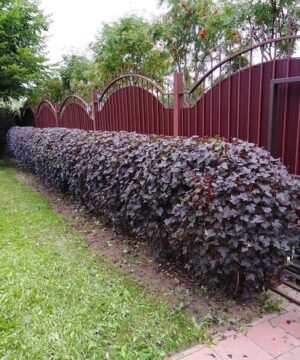
Physocarpus opulifolius 'Monlo' (DiaboloTM)
Purple Leaf Ninebark $6.99 - $39.99 Read more This product has multiple variants. The options may be chosen on the product page -

Deutzia crenata 'Nikko'
Nikko Slender Deutzia $15.99 - $42.99 Read more This product has multiple variants. The options may be chosen on the product page -
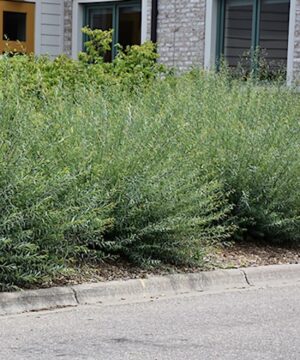
Salix purpurea 'Nana'
Dwarf Arctic Willow, Dwarf Blue Arctic Willow, Purple Willow Out of stock Read more -
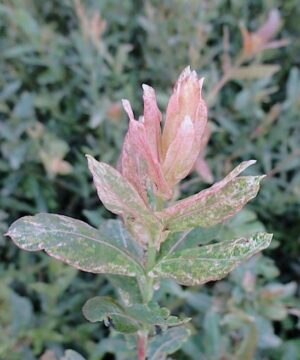
Salix integra 'Hakuro Nishiki'
Hakuro-nishiki Dappled Willow, Japanese Variegated Willow $14.99 Read more This product has multiple variants. The options may be chosen on the product page


