




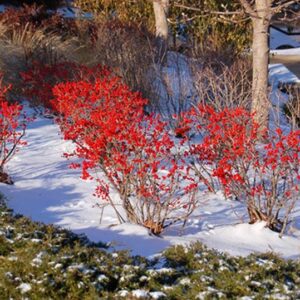

Ilex verticillata (Seedling)
Winterberry, Winterberry Holly, Michigan Holly
- Main interest:
- lovely green foliage, red berries fall and winter, bronzed yellow fall foliage
- Exposure:
- full sun to partial shade
- Soil humidity:
- moist to wet soil
- Flower colour:
- greenish white
- Flowering period:
- June to July
- Foliage:
- dark green
- USDA Hardiness:
- zone 3a: -40 °C (-40 °F) View Zone Map
- Mature height & width:
- height: 10 ft (3 m) width: 6 ft (1.8 m)
- Use:
- hedge, cut flower garden, rain garden, pond margin, stream bed
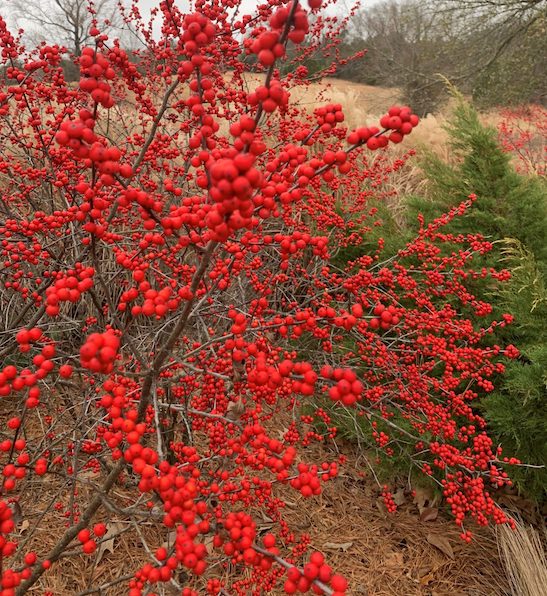
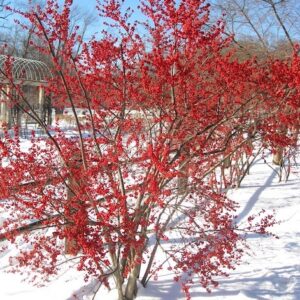
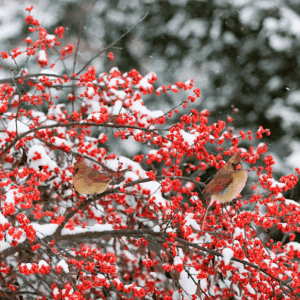
Ilex verticillata, commonly known as Winterberry Holly, produces a profusion of beautiful red berries. Its dense, heavy fruiting branches full of berries will hold all fall. Along with its yellow-bronze autumn foliage they create wonderful fall interest. The luminous red berries, against bare, dark branches will last through the winter. They provide considerable visual interest in the winter landscape.
These Winterberries are seedlings (they were grown from seeds), and are a mix of male and female Winterberries.
Typically growing to 10 feet tall and wide, Ilex verticillata is multi-stemmed and suckering. It has a really nice, rounded habit. It tolerates wet and boggy soil. So, Winterberry Holly plant does well in pond margins, stream beds, or low-lying areas of the yard. Mass planted or in small groups, it performs well as an accent or hedge plant. Berries are a food source for birds. The foliage is also a food source for wildlife including rabbits, and the larvae of the Harris three-spot and pawpaw sphinx moths.
Female Winterberries will need a male Winterberry to pollinate its inconspicuous greenish-white blooms (one male for every 6 -10 females). Flowers bloom on new growth. So, if pruning to shape, do so in early spring before new growth appears. Deer tolerant. Berries are quite showy and will persist throughout the winter, and often into early spring.
- Main interest:
- lovely green foliage, red berries fall and winter, bronzed yellow fall foliage
- Exposure:
- full sun to partial shade
- Soil humidity:
- moist to wet soil
- Flower colour:
- greenish white
- Flowering period:
- June to July
- Foliage:
- dark green
- USDA Hardiness:
- zone 3a: -40 °C (-40 °F) View Zone Map
- Mature height & width:
- height: 10 ft (3 m) width: 6 ft (1.8 m)
- Use:
- hedge, cut flower garden, rain garden, pond margin, stream bed
Ilex verticillata, commonly known as Winterberry Holly, produces a profusion of beautiful red berries. Its dense, heavy fruiting branches full of berries will hold all fall. Along with its yellow-bronze autumn foliage they create wonderful fall interest. The luminous red berries, against bare, dark branches will last through the winter. They provide considerable visual interest in the winter landscape.
These Winterberries are seedlings (they were grown from seeds), and are a mix of male and female Winterberries.
Typically growing to 10 feet tall and wide, Ilex verticillata is multi-stemmed and suckering. It has a really nice, rounded habit. It tolerates wet and boggy soil. So, Winterberry Holly plant does well in pond margins, stream beds, or low-lying areas of the yard. Mass planted or in small groups, it performs well as an accent or hedge plant. Berries are a food source for birds. The foliage is also a food source for wildlife including rabbits, and the larvae of the Harris three-spot and pawpaw sphinx moths.
Female Winterberries will need a male Winterberry to pollinate its inconspicuous greenish-white blooms (one male for every 6 -10 females). Flowers bloom on new growth. So, if pruning to shape, do so in early spring before new growth appears. Deer tolerant. Berries are quite showy and will persist throughout the winter, and often into early spring.
Synonym(s): Prinos verticillatus
Also known as: Common Winterberry, Swamp Winterberry, Virginia Winterberry
Related products
-
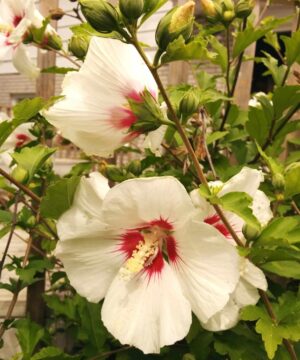
Hibiscus syriacus 'Red Heart'
Red Heart Rose of Sharon $14.99 Read more This product has multiple variants. The options may be chosen on the product page -
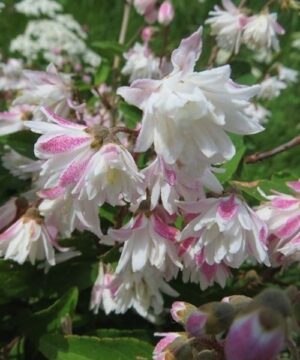
Deutzia x scabra 'Flore Pleno'
Fuzzy Deutzia $14.99 Read more This product has multiple variants. The options may be chosen on the product page -
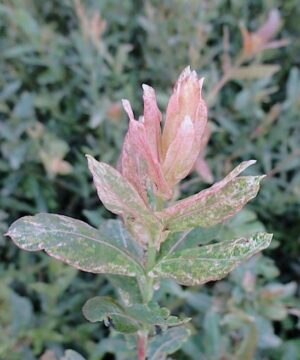
Salix integra 'Hakuro Nishiki'
Hakuro-nishiki Dappled Willow, Japanese Variegated Willow $14.99 Read more This product has multiple variants. The options may be chosen on the product page -

Ligustrum x vicaryi
Vicary Golden Privet Out of stock Read more


